hierarchical-bits
Hierarchical Bits — The Principle
First-Class Interpretation Representation (FCIR) — a working name
From a file format to a property of representation.
The applicability sweep (applicability/) established something
uncomfortable and clarifying: the BH shape — a heavy substrate stored once,
many co-registered layers, selective reads — is already mature SOTA in nearly
every domain where it matters (DICOM, COG/STAC, lakeFS, CRAM/tabix, MAM, S-LoRA,
named graphs). Selling BH as “substrate + overlays” is selling something the
world already has.
So the contribution is not the format. It is a principle the prototypes are instances of — and principles survive where formats age.
The thesis
Hierarchical Bits is not a storage format. It is a way of representing data in which multiple concurrent — and possibly contradictory — interpretations share a single immutable substrate and persist as co-equal, first-class, individually addressable entities; adjudication between them is deferred to read-time and optional, never baked in and never destructive.
We give this property a working name — the First-Class Interpretation Representation (FCIR): a representation in which interpretations are first-class — persistent, addressable, co-equal — rather than temporary versions or conflicts to be resolved away. “First-class” is the load-bearing word: it is what separates an interpretation with independent standing from one that exists only until it is merged into a single truth.
Why “working name.” A property earns a permanent name after it has been observed, tested, and seen to recur across contexts — not at the moment it is first noticed. We are at the start of that sequence, not the end. So the honest statement is not “BH’s contribution is FCIR” (a universal claim) but:
Our investigation identified FCIR as the property that best distinguishes BH from the approaches evaluated.
That is a description of a result, scoped to what we surveyed — not a law, and not a fence around what BH might later turn out to be. If the property proves broader or subtly different as it recurs in new contexts, the name should follow the idea, not constrain it.
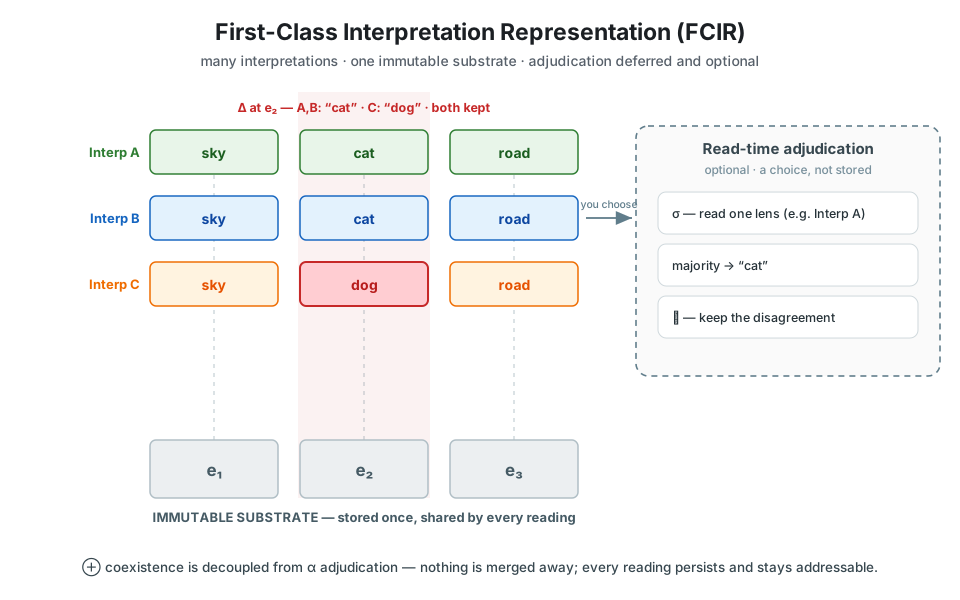
The same model, as text (for readers — human or machine — that don’t render SVG):
   Interp A (alice):  sky   cat   road    ┐
   Interp B (bob):    sky   cat   road    ├ coexist · co-registered · first-class
   Interp C (carol):  sky   DOG   road    ┘ (they disagree at e₂ — both kept)
                       │     │     │
   substrate:          e₁    e₂    e₃       immutable · stored once
                             │
       read-time adjudication (OPTIONAL · not stored):
          σ one lens   ·   majority → "cat"   ·   ⊥ keep the disagreement
A worked example — 3 annotators, one image
Substrate:  image #042  — stored once (the pixels)
Interp A (alice):  { object: "cat" }
Interp B (bob):    { object: "cat" }
Interp C (carol):  { object: "dog" }        ← disagreement, preserved

Reads (all over the one stored image):
  layer("carol")        → { object: "dog" }
  item_views("#042")    → { alice:"cat", bob:"cat", carol:"dog" }   # the matrix
  adjudicate(majority)  → "cat"      # optional, at read time; the layers stay
  disagreements()       → ["#042"]   # found by reading labels only, not the image
What FCIR changes vs today: current pipelines collapse A, B, C into a single gold
label and discard the fact that carol disagreed. FCIR keeps all three
first-class and lets each consumer adjudicate — or not — at read time. This is
exactly the bhanno prototype.
The distinguishing test
What separates a BH representation from an ANCHOR system (one that also
stores the substrate once and reads it selectively)?
Given two interpretations that disagree about the same element of the substrate, can both remain — permanently, queryable, neither marked wrong — until a reader chooses, or declines, to adjudicate?
ANCHORsystems answer no. They converge to one canonical truth: a consensus mask, a gold label, a final coding decision, a merged model, a resolved clash. Disagreement is a problem to be resolved — noise on the way to ground truth.- BH answers yes. Disagreement is data to be preserved. The rival readings coexist as permanent residents; the system never forces one to win by erasing another.
That single yes/no is the whole difference.
The four properties
| # | property | shared with ANCHOR? |
|---|---|---|
| 1 | Immutable shared substrate — stored once, referenced by all layers | yes — already SOTA |
| 2 | Interpretations as first-class entities — persistent and addressable, not on-the-fly derived views nor mergeable annotations | partly |
| 3 | Coexistence of contradiction — rival readings of the same element are preserved together, as data | no — the differentiator |
| 4 | Deferred, optional adjudication — at read time the reader picks a lens: one interpretation / the matrix / the majority / the disagreement | no — the differentiator |
Property 1 is the part that is already everywhere. Properties 3 and 4 are the part the sweep found still under-explored: most systems treat rival interpretations as a mess to clean up, not as co-equal entities to keep.
How FCIR relates to adjacent systems
A blind read test (five fresh reviewers, three model tiers, README only) converged on one verdict: the message is clear, but the novelty is not yet defended — every reviewer independently named existing systems they believed already do this. They were right to. Here is the confrontation, under one rule: where a system already does exactly this, we say so — no makeup.
The FCIR property has five parts: (1) one shared, immutable substrate; (2) interpretations that may contradict; (3) kept as first-class, addressable, co-equal entities; (4) co-registered to the same substrate elements; (5) adjudication deferred and optional — neither reading marked wrong.
| system | satisfies all five? | honest verdict |
|---|---|---|
| RDF named graphs + PROV | yes, for triples | already FCIR, in the triple/KG domain |
| Standoff annotation (W3C Web Annotation, UIMA/GATE) | yes, for text/media | already FCIR, in the annotation domain |
| Git / branches | no | defers adjudication, but is built for eventual merge; branches are divergent whole-tree states, not co-equal readings co-registered per element |
| Bitemporal DBs / Datomic | partial | immutable + non-destructive history, but temporal supersession of one truth, not co-equal simultaneous rivals from different interpreters |
| CRDTs | no (opposite intent) | designed to auto-converge to one state without coordination; preserving disagreement is exactly what they remove (multi-value registers keep concurrent values only until the app resolves) |
| Event sourcing | no | immutable log + many derived projections, but the projections are different shapes of one truth, not contradictory rivals |
The admission, without makeup. Two of these — RDF named graphs with
provenance and standoff annotation — already implement the FCIR property in
full, each within its own domain. Our bhanno prototype is standoff
annotation; it did not invent it. For triple-shaped knowledge, named graphs got
there twenty years ago. So FCIR is not a new mechanism, and any claim that
“nobody does this” is false.
What is left, then — stated at its honest size. FCIR is an architectural synthesis and a name, not an invention:
- a single name for a property that today exists only in domain-specific forms (named graphs for triples, standoff for text) and has no shared term across images, BIM models, model weights, agent memory;
- a falsifiable test — can two readings of the same element both remain, neither marked wrong, until adjudication is chosen? — that classifies any system in one line;
- the observation that the property recurs across domains that do not talk to each other, and that most systems in most domains do not have it (they converge, merge, or supersede).
That is a smaller claim than “a new representation paradigm.” It may still be useful — naming a recurring property and giving it a test is how scattered practice becomes a discussable concept — but it stands or falls as a synthesis, and an honest reader should judge it as one, not as a mechanism that did not exist before.
Discipline, not paradigm — naming the contraction
This investigation began with a larger ambition (“not a change of form, a change of paradigm”) and has, under measurement, contracted to a smaller and firmer claim — and that contraction should be named, not left for the reader to infer.
FCIR is a well-modeled discipline, not an impossible capability. Its value is not “nobody can do this without FCIR” — the disagreement-compute test shows an uncollapsed
(item, source, value)table already answers every query abhmemx-style store does (4/4). Its value is: a single name, a falsifiable test, formal operators (⊕ Δ σ α ▷), and the discipline of not collapsing on write — given to a practice that industry workflows systematically abandon.
A paradigm breaks when something was impossible before and is possible now
(relativity changed the physics). Nothing here was impossible — disagreement was
always a GROUP BY away in an uncollapsed table. What is real, and enough for a
contribution, is that the prevailing practice destroys that table by default,
and FCIR names, tests, and models the alternative. We claim the discipline; we do
not claim the impossibility.
The discipline carries measurable signal — not only provenance. Tested on ChaosNLI (3113 disagreement-rich NLI examples, ~100 human annotations each; full result): training on the full human label distribution (“don’t collapse on write”) predicts human judgments ~7% better (JSD) than collapsing to a gold label, and beats generic label smoothing — so the gain is the shape of the disagreement, not mere regularization. The effect grows monotonically with how contested the example is, and costs no accuracy. So “don’t collapse” is not only auditable; on this benchmark it is also predictively better. (Scoped honestly: modest effect; proves the signal has value, not that FCIR-the-mechanism is necessary — soft-label learning is known; what is new is tying it to “don’t collapse on write” and showing it beats the smoothing control.)
A formal algebra of these operators — coexistence ⊕, conflict Δ,
projection σ, adjudication α, precedence ▷ — with FCIR stated precisely as
⊕ ⊥ α (coexistence decoupled from adjudication), is in
BH_ALGEBRA.md. It is what answers “a model, or just a
pattern?” — as a specification, not yet a verified theory.
The prototypes are instances, not the point
Each .bh prototype is one instance of the principle — and they vary in how
sharply they exercise properties 3–4:
| instance | substrate | rival interpretations | adjudication deferred? |
|---|---|---|---|
bhanno |
a media item | K annotators that disagree | yes — adjudicate() is optional; the purest instance |
bhmem |
the interaction log | conflicting belief/fact versions over time | partial — rival temporal versions kept |
bhckpt |
base model weights | adapters / quantizations (alternative, mostly additive) | weak — interpretations rarely contradict |
bhtrace |
the span tree | competing analysis lenses / root-cause hypotheses | weak — lenses coexist more than contradict |
bhbim (candidate) |
the building object-graph | rival discipline/version overlays + clashes | yes — the one BUILD domain in the sweep |
The closer an instance sits to “rival readings preserved without forced
adjudication,” the more it expresses what is new about BH versus the ANCHOR
systems. bhanno (and the proposed bhbim) are the sharp instances; the others
demonstrate the generalization but lean on the already-SOTA substrate-sharing.
Honest scope
- This is the differential observed so far, in the 20 domains surveyed — not a closed claim that properties 3–4 are BH’s only possible value. New domains may surface other under-served slices.
- The substrate-sharing economics (property 1) remain real and measured in the prototypes — they are just not novel. BH’s claim there is credibility by analogy, not invention.
- “Without forced adjudication” is a representation stance, not a truth claim: BH surfaces the contest and the majority; it does not decide who is right. Resolving truth stays a modeling choice the reader makes, or declines.
- The optionality can be illusory downstream. Many consumers need a single resolved value, not a matrix — so “deferred adjudication” often means “deferred to the next system in the pipeline, which then force-adjudicates.” FCIR’s optionality is real in the store; whether it survives to the point of use depends on whether any downstream consumer is willing to carry the matrix instead of demanding a scalar. Where every consumer demands a scalar, FCIR buys provenance and auditability, not genuine deferral.
- It scales in K, but the storage win saturates. A
scaling probe (200 facts, K = 3 → 100 agents) shows the
marginal cost of agent K+1 is flat (~one belief layer; linear, no
explosion) and read-time compute over the whole matrix stays sub-20 ms at
K = 100. But the storage saving vs K independent copies saturates (≈1.7× →
2.8×, then flat): once the per-agent layers dominate the shared substrate, the
“stored once” economy stops growing. The case for FCIR at high K is the
discipline and the single model — not an unbounded storage advantage.
The sharper high-K argument is workflow, not bytes (unmeasured here, but
worth naming): in an
ANCHORsystem the cost of adjudication scales with K in human time (committee, majority rule, review UI) — O(K) per resolved value. FCIR does not remove that cost; it defers it to whoever actually needs a resolved value. With 100 agents but only 3 consumers that need a scalar, you pay adjudication 3 times, not 100. That is the real economic case for “don’t collapse on write” at scale.
Why this is the advance
It moves the centre of gravity from the file to the model. If the thesis above can be stated precisely — and the distinguishing test makes it falsifiable: does this system preserve contradicting interpretations without adjudication, or not? — then the value of BH stops depending on any single prototype and starts depending on the clarity and generality of the principle. The prototypes become evidence; the principle becomes the contribution.
Companion to BH_MASTER.md (the measured study) and
applicability/ (the domain sweep). A Portuguese version can
be produced on request.